Pills, Potions, and Plausible Deniability: Omaha's Shadow Healer Who Kept Getting Away With It
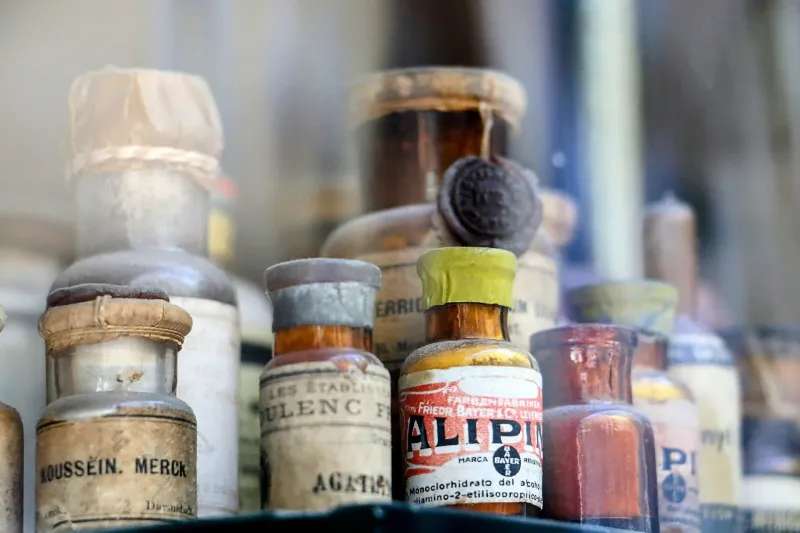
Let's be clear about one thing upfront: the Mystery Man of Omaha does not endorse unlicensed medical practice. We also do not endorse jaywalking, feeding pigeons in prohibited zones, or whatever the 1920s equivalent of a terms-of-service violation was. That said, we absolutely do endorse a good mystery, and the case of Omaha's so-called Phantom Pharmacist — a figure who dispensed remedies, salves, tinctures, and apparently very good advice for several decades without a single verifiable credential — is one of the most delightful rabbit holes this city has ever produced.
So pull up a chair, check your blood pressure the old-fashioned way (worry about it quietly), and let's dig in.
The Rumors Start, As They Always Do, With a Grandmother
Oral histories are a funny thing. By the time a story reaches its fourth or fifth generation of retelling, it has acquired the texture of myth — polished smooth by repetition, embellished at the edges, and absolutely impossible to fact-check. But when multiple families, across multiple neighborhoods, tell versions of the same story without any apparent connection to each other, even the most skeptical amateur investigator has to sit up straight.
In the South Omaha neighborhoods that absorbed wave after wave of immigrant communities in the early 1900s, there circulated a persistent whisper about a man — sometimes described as elderly, sometimes described as middle-aged, occasionally described as a woman in disguise, which honestly raises more questions than it answers — who could be found at a particular address (the address changed depending on who was telling the story) and who would, for a modest sum or sometimes nothing at all, provide you with something for what ailed you.
Not a doctor. Not a pharmacist. Not anything with a framed certificate on the wall. Just someone who knew things.
What the Newspapers Actually Said (Which Wasn't Much, Suspiciously)
Here's where it gets interesting. Searches through archived editions of Omaha's major newspapers from roughly 1910 through the late 1940s turn up a handful of oblique references that, taken individually, seem like nothing. Taken together, they start to look like a pattern someone was trying very hard not to draw attention to.
A 1923 item in a local paper references a raid on a "purveyor of unregistered medicinal compounds" in a neighborhood near the old meatpacking district, with no name attached to the proprietor and no follow-up coverage. A 1931 letter to the editor complains about "certain individuals operating outside the bounds of legitimate pharmacy" without specifying who or where. A 1938 human interest piece about a South Omaha family's recovery from a mysterious winter illness includes a throwaway line — almost certainly added and then almost certainly regretted by the editor — about a "neighborhood remedy man" whose treatment preceded the family's visit to a licensed physician.
The Nebraska State Board of Pharmacy's records from this era, where they survive at all, contain several investigations that were opened and then, with remarkable consistency, quietly closed. No convictions. No named defendants in any accessible record. Just a lot of paperwork that goes nowhere, which is either evidence of a very savvy operator or a very complicated relationship between the authorities and the communities they were supposed to be policing.
One Person or Many? The Rotating Cast Theory
Here is the hypothesis that keeps serious researchers up at night: what if the Phantom Pharmacist was never one person?
Several families who shared recollections for this piece — descendants of Czech, Polish, and Italian immigrants who settled in Omaha's south and east sides — described the figure in ways that are subtly but meaningfully inconsistent. The healer their great-grandparents consulted in the 1910s was apparently quite old. The one their grandparents remember from the late 1930s was described as vigorous and relatively young. The remedies, interestingly, were often similar: poultices for respiratory ailments, bitter liquid preparations for digestive complaints, and in at least two accounts, a specific treatment for a skin condition that one descendant describes as "basically working, which is more than I can say for what the actual doctor gave us."
The working theory among those who've spent time with this material is that what Omaha had was less a single rogue pharmacist and more a tradition — a body of knowledge passed laterally through immigrant communities who had genuine reasons to distrust official medicine, genuine financial barriers to accessing licensed care, and genuine folk pharmacological expertise imported from the old country. The "Phantom Pharmacist" may have been a role more than a person.
Which, if anything, makes the legend more interesting.
Why the Authorities Kept Losing
This is the part that really stings for the medical establishment's historical reputation. Every documented attempt to shut down whatever this operation was seemed to generate precisely the opposite of the intended effect. Communities that had been quietly tolerating the shadow healer's existence became actively protective the moment outside pressure appeared. Witnesses developed sudden, comprehensive amnesia. Addresses that had been common knowledge became impossible to pin down.
One interpretation — the cynical one — is that the medical licensing apparatus of the early 20th century was not exactly beloved in immigrant neighborhoods, where it was often experienced as a gatekeeping mechanism that kept costs high and access limited. Protecting the Phantom Pharmacist wasn't necessarily about believing in the cures. It was about refusing to hand a community resource over to institutions that hadn't earned the community's trust.
Another interpretation is that the remedies actually worked often enough to justify the loyalty. We'll leave that one for the historians and the pharmacologists to argue about.
What Remains
No grave marker. No license application. No photograph anyone has been willing to produce. What remains is a constellation of secondhand memories, a few suspiciously incomplete official records, and the stubborn conviction among several Omaha families that someone, at some point, helped their ancestors when the system wouldn't.
The Mystery Man of Omaha has, at this point, developed a professional appreciation for figures who manage to move through history without leaving a clean paper trail. It's a skill. It's an art form. And in this particular case, it may have been a lifeline.
If your family has a story — a remedy, a name, an address that "everyone knew about" — our inbox is, as always, open. We promise to handle it with the appropriate combination of journalistic rigor and complete inability to let a good mystery go.