Blueprints and Bones: Mapping the Forgotten Layers Beneath Old Market Cobblestones
Let me be upfront with you: I have spent an unreasonable amount of time staring at 19th-century utility maps. My optometrist is concerned. My wife thinks I have a problem. And yet, every time I unroll another brittle sheet of architectural drafting paper and squint at the faded ink, I find something that makes me think Omaha's underground is not just a quirky footnote — it is a full, sprawling chapter the city never finished writing.
We have talked about the tunnels before. Everybody talks about the tunnels. The Old Market tunnel network is practically a local brand at this point, the kind of thing that gets mentioned on walking tours between the artisan cheese shop and the cocktail bar with the exposed brick. But here is the thing about the tunnels: they are the part of the story that survived. What about everything else?
The Paper Trail Nobody Asked For
The Douglas County Historical Society is not a glamorous destination. There is no fog machine, no dramatic lighting, no ominous organ music. What there is, however, is an archive full of documents that most people will never bother to read, and that is exactly where things get interesting.
City infrastructure records from the 1880s and 1890s show a surprisingly ambitious underground ambition for a young Midwestern city. Omaha was booming — the Union Pacific had made it a railroad hub, the stockyards were pulling in serious money, and civic leaders were eager to prove that this was not just a dusty waypoint on the way to somewhere more important. That ambition extended downward.
Beyond the well-documented utility tunnels used for steam heating and storage, older records reference what appear to be loading corridors beneath several warehouse blocks that no longer exist above ground. The warehouses were demolished or repurposed. The corridors, according to city engineers interviewed by the Omaha World-Herald in a 1974 feature that almost nobody remembers, were simply... left alone. Sealed. Forgotten. Not filled, not demolished — just closed off and removed from the active maintenance schedule.
That is a city government move so passive it almost deserves its own category of neglect.
What the Historians Will (and Won't) Say
Local historian and Old Market preservation advocate Margaret Theis — who has spent decades cataloguing the neighborhood's architectural history and is approximately zero percent interested in my theories — will confirm that the infrastructure beneath the Old Market is "significantly more complex than most residents understand." She stops short of confirming anything dramatic, but she also does not laugh me out of the room, which I consider a personal victory.
What she does say, carefully and with the measured tone of someone who has dealt with enthusiastic amateurs before, is that the transition from 19th-century warehouse district to modern entertainment neighborhood happened quickly enough that not every structural element was properly documented. Some things were simply built over.
A former city engineer, who agreed to speak on background because he did not want to be associated with what he called "the treasure hunter crowd," confirmed that during a utility upgrade project in the early 2000s, workers encountered a bricked-up archway beneath Howard Street that did not appear on any current city blueprint. It was assessed, determined to be structurally isolated, and re-sealed. No further investigation was conducted. The paperwork on that encounter is, shall we say, sparse.
The Legends That Refuse to Die
Now, I want to be responsible here — Mystery Man of Omaha is many things, but we are not in the business of manufacturing ghosts where there are none. So let me be clear: the more colorful underground legends deserve some scrutiny.
The persistent rumor that bootleggers used an extensive tunnel system during Prohibition to move product between the Old Market warehouses and nearby establishments is partially supported by historical record. Omaha had a robust and largely unapologetic relationship with illegal liquor during the 1920s, and the stockyard money that funded much of downtown's infrastructure was not always accompanied by a strong moral compass. That some of those tunnels were repurposed for illicit storage? Plausible. That there is a secret underground speakeasy perfectly preserved beneath 10th Street with original bar stools and a jazz band frozen in time? Probably not.
Similarly, the claim that certain passages connect all the way to the Missouri River bluffs is almost certainly an exaggeration — though the geology of the area does include natural limestone formations that early settlers used for cold storage, and the line between "natural cave" and "expanded passage" is not always obvious in 150-year-old records.
What We Actually Know, and What We Don't
Here is the honest accounting, as best as the Mystery Man can manage:
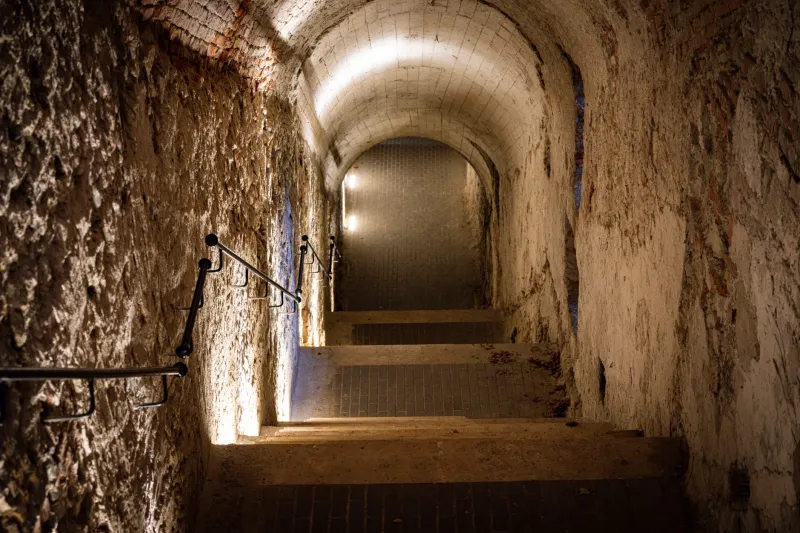
Confirmed: Brick-lined utility tunnels exist beneath several blocks of the Old Market and were actively used for steam distribution and storage through at least the mid-20th century. Some sections remain accessible; others have been sealed or collapsed.
Plausible but unverified: Additional loading and storage corridors from the warehouse era exist in isolated pockets, sealed off rather than demolished, and are not reflected in current city records.
Unknown: The full extent of any connected passage system, the condition of sealed sections, and whether any spaces of historical or architectural significance remain intact beneath the current streetscape.
Probably folklore: The speakeasy. The river connection. The anything involving treasure.
The city has no active program to survey these spaces, partly because doing so would raise questions about structural liability, and partly because — and I say this with genuine affection for Omaha's civic personality — the city has a long tradition of deciding that some things are fine to just leave alone.
Why It Matters (Beyond the Mystery)
Here is the part where I put on my serious hat, which is admittedly still a detective hat but a more thoughtful one.
Understanding what is beneath the Old Market is not just a curiosity project. As the neighborhood continues to develop, as utility infrastructure ages and gets replaced, and as the city considers various expansion and renovation projects, running into unexpected underground structures creates real complications. The surprise archway from 2002 is a small example. A larger, undetected void during a major construction project is a much less fun surprise.
Several preservation advocates have quietly pushed for a more systematic underground survey — ground-penetrating radar technology makes non-invasive assessment more feasible than ever. So far, that push has not gained much traction.
Until it does, the layers beneath the cobblestones remain exactly what they have always been: a mystery that Omaha is mostly content to walk over without looking down.
I, for one, am still looking down.