Erased in Plain Sight: Omaha's Underground Railroad Hiding Spots and the Silence That Swallowed Them
Let's establish something right up front: Omaha has a mystery problem. Not the fun kind where someone leaves a cryptic note in a diner booth — the uncomfortable kind where entire chapters of the city's history seem to have been quietly folded up, tucked behind a false wall, and forgotten. Intentionally.
This is one of those chapters.
In the 1850s and 1860s, Omaha was a raw, scrappy frontier town clinging to the western bank of the Missouri River. It was also, for a brief but electrifying period, one of the most important waypoints on the Underground Railroad — the clandestine network of safe houses, sympathetic farmers, church basements, and exceptionally brave human beings who helped enslaved people escape north and west toward freedom. Omaha's location was practically custom-built for the role: sit on one side of the river, and you're in Nebraska Territory, technically free soil. Sit on the other side, and you're in Missouri, a slave state where bounty hunters operated with full legal backing.
People crossed that river in the dark, in the cold, in flat-bottomed boats with no lights. And when they got to the Nebraska side, someone was waiting.
The question — and it is a genuinely maddening one — is why we barely talk about who that someone was, or where they hid people, or what happened to those hiding places.
The Paper Trail That Keeps Going Cold
Here's where the Mystery Man methodology kicks in. You start pulling threads.
Documented historical records confirm that Omaha had an active abolitionist community in the territorial period. The Nebraska Freeman, an anti-slavery newspaper, operated in the city. Congregationalist and Methodist churches in the area had known abolitionist sympathies. A handful of names — John Allen, Dr. Enos Lowe, and a few others — appear in scattered historical accounts as individuals who assisted freedom seekers.
But try to find the addresses. Try to find the buildings. Try to find a walking tour, a historical marker, a plaque on a brick wall that says "here, in this basement, a human being hid from people who wanted to drag them back into bondage."
You will mostly come up empty.
Local historians who've spent years on this subject describe hitting the same wall repeatedly. "The documentation exists in fragments," one researcher familiar with Nebraska's territorial history explained. "Church records, personal diaries, a letter here and there. But it was intentionally fragmented — people weren't writing this stuff down in ledgers because doing so could get them arrested or worse. The secrecy that protected people in the 1850s also erased them from the historical record."
That's the cruel irony of the whole thing. The Underground Railroad worked because it was invisible. And it stayed invisible long after it stopped needing to be.
The Suspects on the Map
So where do researchers think these safe houses actually were? This is the part where we get to put on our metaphorical detective hats and stare at an old city map with a magnifying glass.
Several locations have been flagged by historians as probable — not confirmed, but circumstantially compelling:
The Near North Side. This neighborhood, which would later become the heart of Omaha's Black community, had early roots in freedom-seeker settlement. Several families who escaped enslavement and stayed in Omaha rather than continuing north settled in this general corridor. Where there were settled freedom seekers, there were often the networks that got them there.
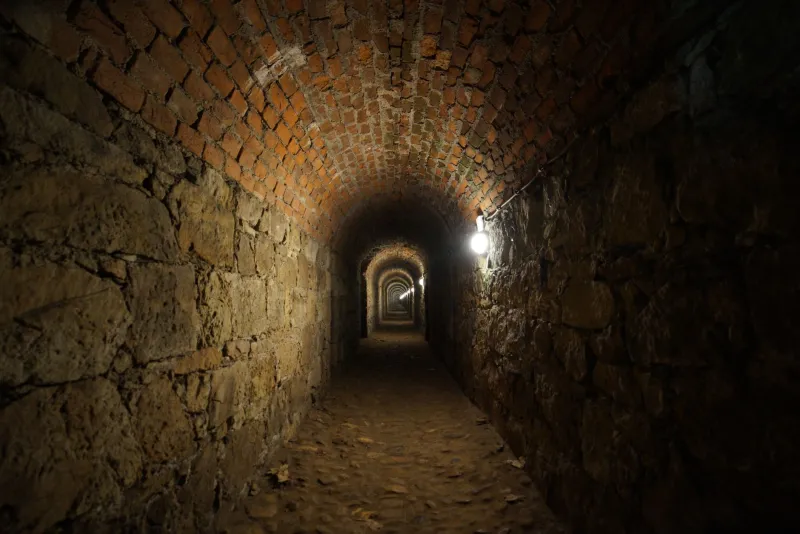
Certain Old Market-Adjacent Properties. Before the Old Market was a destination for brunch and artisan candles, it was a working warehouse district full of cellars, tunnels, and the kind of architectural ambiguity that made hiding people genuinely feasible. We've written before about the tunnel network under those cobblestones — and it's worth noting that some of those passages date to exactly this period.
Early Church Sites in Midtown. At least two congregations with documented abolitionist leanings operated in what is now Midtown Omaha. The original buildings are long gone, but the lots remain, occupied by later structures. Nobody has excavated them. Nobody has looked.
River-Adjacent Properties in Florence. Florence, now a neighborhood on Omaha's north side, was a separate settlement in the territorial era — and its position on the Missouri made it a logical first stop for people crossing the river. A few property records from the 1850s list structures that no longer exist and owners whose names appear in abolitionist circles elsewhere in the historical record.
None of this is a smoking gun. All of it is worth taking seriously.
Why the Silence?
This is the question that keeps nagging. The Underground Railroad is celebrated history. It's taught in schools. There are museums, monuments, and heritage trails in dozens of American cities. So why has Omaha been so slow — some would say so reluctant — to claim this part of its story?
Theories vary. Some historians point to the fact that Nebraska's Civil War-era politics were genuinely complicated — the state had significant pro-slavery factions, and the postwar decades weren't exactly a moment when anyone was eager to advertise who had been on which side of that argument. Celebrating the Underground Railroad meant implicitly naming the people who had opposed it, and in a frontier town where those families still held land and influence, that was awkward.
Others point to something more structural: the history of Black Omaha has been systematically underfunded, underarchived, and undervalued for generations. The stories that get preserved are the stories that get resourced. And for most of Omaha's institutional history, that calculus did not favor this chapter.
A few people will tell you, with a kind of exhausted directness, that it's about who gets to be the hero of a city's origin story — and that Omaha's dominant civic mythology has always centered certain founders and certain neighborhoods, leaving others in the margins.
What's Still Out There
Here's the genuinely exciting part, if you're the kind of person who reads a website called Mystery Man of Omaha: this history is recoverable. It hasn't been destroyed. It's been misfiled.
Oral histories collected from longtime North Omaha families contain fragments. Church archives, some of them unsorted and undigitized, sit in storage. Property records from the territorial period exist at the Nebraska State Historical Society. Architectural surveys of older structures occasionally turn up features — hidden rooms, sealed cellars, unusual interior configurations — that don't have obvious explanations.
Some researchers are quietly doing this work right now. Piecing it together. Cross-referencing names. Walking lots where buildings used to stand.
If you know something — if your family has a story, if you've got an old letter or a property record or a grandmother's account of what happened in a particular basement on a particular night in 1857 — the Mystery Man of Omaha is, as always, extremely interested in hearing about it.
The hiding places kept their secrets for 170 years. It might be time to let a few of them out.