Two Hundred Faces and Zero Last Names: The Mystery Photo Album That Omaha's Thrift Store Shoppers Cannot Stop Talking About
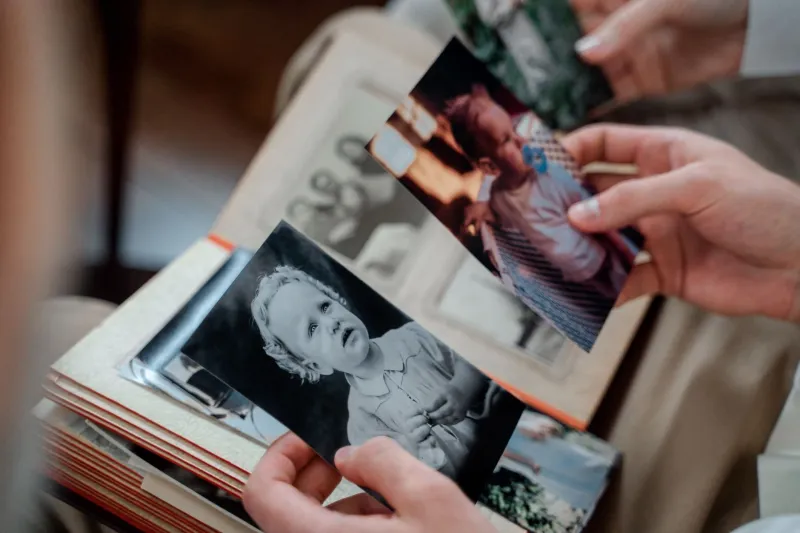
Most thrift store photo albums are sad in a straightforward way. Somebody's grandparents on a beach. A birthday party with a cake that says "Happy 40th, Ron." The visual evidence of a life that mattered to someone and now costs seventy-five cents.
This one is different. This one is a puzzle that someone built on purpose.
The Find
The shopper who found it — she goes by MarcelleInOmaha on the vintage finds forum where she first posted about it, and she's asked us to keep it that way — wasn't expecting much when she pulled it from the shelf. It was a standard black cloth album of the type that was popular from the 1930s through the early 1950s, the kind with little black corner mounts holding each photograph in place. Heavy. Well-made. The kind of album you bought when you intended to keep things.
Inside were approximately two hundred photographs. Black and white, mostly, with a handful of early color snapshots that date the later images to the mid-to-late 1940s. The subjects are, without exception, well-dressed. We're talking fur stoles, white dinner jackets, women with the kind of hair that required professional assistance. These are not backyard barbecue photographs. These are people who knew they were being documented.
And every single one of them has been carefully, deliberately labeled — but only halfway.
"Dorothy and F.W., New Year's 1938." "The Colonel and Bess at the Hunt Club, June." "R.H.M. with the Creighton boys." "Vivian — always late to everything."
First names. Nicknames. Initials that could mean anything. The surnames are simply absent, as if someone went through the entire album with an editorial eye and removed every detail that would make these people findable.
Why Would Someone Do This?
This is the question that's driven three thousand comments on the original forum post and counting.
The most innocent explanation is also the least satisfying: whoever compiled and annotated the album simply assumed that future viewers would know who these people were. That "Dorothy" would be obvious to any family member who picked it up. That "the Colonel" needed no further introduction.
But that explanation falls apart when you look at the album's construction carefully. The annotations aren't casual. They're written in a consistent hand using what appears to be a fine-point pen, in ink that was applied deliberately and at some remove from when the photographs were taken — the handwriting style is too uniform, too considered, to be the spontaneous captions of someone labeling as they went. This was a retrospective project. Someone sat down with these photographs at some point and made choices about what to include and what to leave out.
The second explanation — the one that makes this a Mystery Man of Omaha story rather than a pleasant vintage curiosity — is that the omissions were intentional in a more protective sense. That the people in this album had reasons to be unidentifiable to anyone outside their immediate circle. That "F.W." and "the Colonel" and "R.H.M." were names that, if written out in full, would have meant something uncomfortable.
What the Photographs Reveal
Through careful examination of the images and some genuinely impressive archival detective work by members of the online community who've taken up the cause, several things have become clear.
The settings are identifiable even when the people aren't. At least eleven photographs were taken at what appears to be the same private club or dining establishment — the wallpaper pattern is distinctive enough that one forum member, a professional interior designer, dated it with reasonable confidence to a 1935-1940 installation. Two photographs show an outdoor event with a partial building facade in the background that another contributor has tentatively matched to a structure that stood on Dodge Street until the mid-1960s.
These are Omaha photographs. That much is close to certain.
The social register clues are also there for anyone who knows where to look. The Hunt Club reference in one caption points toward a specific stratum of Omaha society. The Creighton connection in another suggests university or Catholic community ties. A photograph labeled simply "the night everything changed, 1941" — which someone clearly found too significant not to note, but too dangerous to specify — shows eight people in formal dress raising glasses in what appears to be a private toast.
Eight people. A night that changed something. December 1941 is an obvious candidate, but there are other nights that changed things for specific people in specific ways.
The Faces Themselves
Facial recognition technology, applied carefully and with appropriate caveats about its limitations on historical photographs, has produced a handful of tentative matches to public figures who appear in Omaha newspaper archives from the period. We're not publishing those matches here, because tentative is doing a lot of work in that sentence and we prefer our legal department relaxed.
But one recurring face is striking enough to mention without naming. A woman who appears in at least thirty of the two hundred photographs — more than any other individual — is captured in settings that range from clearly public events to what appear to be very private moments. She's always well-dressed. She's always composed. And in every single photograph, she's positioned in a way that suggests she knew exactly where the camera was and had made a decision about how to present herself to it.
Somebody loved this woman enough to photograph her constantly. And somebody — maybe her, maybe someone else — made sure that whoever found this album decades later would never know her last name.
The Crowdsource
MarcelleInOmaha has digitized the entire album and posted it to a dedicated community page where contributors from Omaha and beyond have been submitting identifications, theories, and archival cross-references for months. Progress is real but slow. Roughly forty of the two hundred photographs have at least a working theory attached to them. The other hundred and sixty remain stubbornly anonymous.
If your family has roots in Omaha's social scene from the 1930s and 1940s — the clubs, the charity circuits, the university networks, the professional associations — we'd like you to take a look. Not because we're trying to expose anyone. Most of these people have been dead for decades.
But whoever put this album together wanted it to survive. They kept it intact, organized, annotated. They just didn't want it to be too easy.
We figure the least we can do is try to honor the puzzle they left behind.