Dead or Alive: The Omaha Socialite Who Drowned in 1952 and Kept Making Withdrawals
There is a particular kind of Omaha story that the city's establishment has always preferred to keep filed under Unresolved rather than Scandalous. The kind where the principals are well-dressed, the addresses are west of Dodge, and the questions get quieter every decade until they stop being asked at all. The alleged disappearance — or death, depending on who you believe — of Eleanor Voss Hartwell in October of 1952 is exactly that kind of story.
And yet, here we are. Asking.
A Woman Worth Noticing
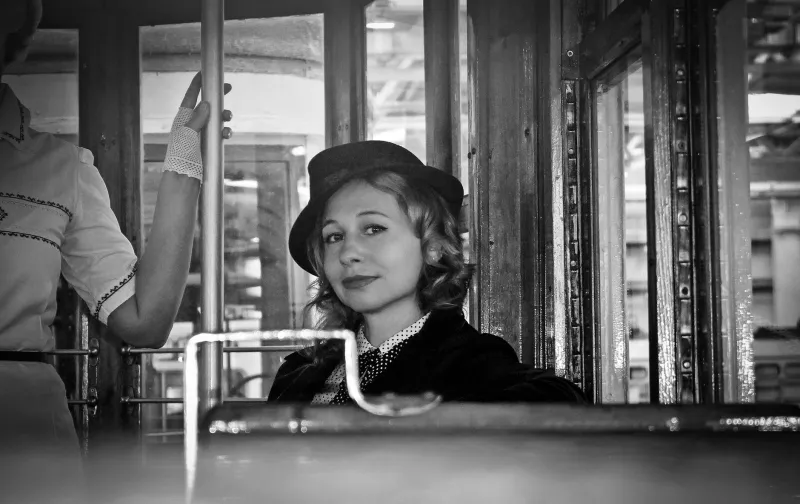
Eleanor Hartwell, née Voss, was the sort of person whose photograph appeared in the Omaha World-Herald's society pages so regularly that readers probably felt they knew her. The wife of a grain commodities broker with deep Nebraska roots, she was a fixture at charity luncheons, an enthusiastic patron of the Joslyn Art Museum, and, by all accounts, impeccably turned out at every function she graced. She was forty-one years old in 1952. She had a daughter in boarding school in Vermont, a husband who traveled frequently on business, and a social calendar that would exhaust a woman half her age.
She also had, according to people who knew her well enough to lower their voices, a private life that did not match the public one. The specifics varied depending on who was doing the telling. A standing disagreement with her husband over finances. A friendship with a Kansas City man that raised eyebrows in certain circles. A trip to Chicago in the summer of 1952 that she declined to explain to anyone, including her closest friends.
None of this made her unusual by the standards of Omaha's mid-century elite. What made her unusual was what happened on the evening of October 14th.
The River and the Absence of Evidence
According to the official account — and here the Mystery Man must note that official is doing considerable heavy lifting — Eleanor Hartwell was seen walking along the riverbank south of the Douglas Street Bridge by two witnesses whose names appear in the initial police report but whose subsequent statements diverged in ways that were never satisfactorily reconciled.
The first witness, a retired postal worker named Gerald Fitch, told investigators he saw a woman matching Eleanor's description standing at the river's edge sometime after eight o'clock in the evening. He described her as standing still and looking across the water, which is either poetic or suspicious depending on your disposition.
The second witness — a woman who asked not to be identified in the press at the time and whose anonymity has remained frustratingly intact ever since — told a different story. She claimed to have seen a woman matching Eleanor's description getting into a dark-colored automobile on a side street two blocks from the river, approximately forty-five minutes after Fitch's sighting. The car, she said, was already running. Someone was waiting.
Police searched the river for three days. No body was recovered. No clothing. No personal effects. The Missouri being the Missouri, investigators noted that the current could carry a body a considerable distance before depositing it somewhere inconvenient for everyone, and that absence of remains did not rule out drowning. The case was classified as a presumed accidental death.
Eleanor Hartwell was declared legally dead in 1955.
The Ledger That Wouldn't Close
Here is where the story gets genuinely strange, and where the Mystery Man starts reaching for a second cup of coffee.
In the years following Eleanor's disappearance, a personal savings account held in her name at a downtown Omaha bank — separate from the joint accounts she maintained with her husband — continued to show periodic withdrawal activity. These were not large sums. They were modest, irregular, and conducted via third-party instruments that made direct attribution difficult. The account was not formally closed until 1958, six years after Eleanor vanished and three years after her legal death declaration.
The bank, naturally, has never confirmed the specifics of this account. What we know comes from a letter written in 1971 by a former bank employee — unearthed in a Dundee estate sale in 2003 and donated to a local historical archive by a collector who clearly understood its value — in which the employee described the situation to a friend with what reads as genuine bewilderment. The withdrawals stopped the year the husband remarried, the letter notes. Make of that what you will.
We are making quite a lot of it, frankly.
What the Society Pages Didn't Say
The World-Herald's coverage of Eleanor's disappearance was, by modern standards, remarkably restrained. A brief notice of her presumed death. A small tribute from the Joslyn auxiliary. Her husband's statement, which expressed grief in language so formal it reads today like a legal brief.
But the gossip columns — those glorious, catty, semi-coded dispatches from Omaha's social interior — told a subtler story in the months that followed. References to a certain west Omaha household adjusting to a quieter arrangement. A pointed observation that the Hartwell family's annual Christmas party, a fixture on the social calendar for fifteen years, was not held in December of 1952. A single cryptic line in a January 1953 column: Some absences are mourned. Others are simply noted.
The columnist responsible for that line died in 1979 and took whatever she knew to Prospect Hill Cemetery.
The Daughter's Silence
Eleanor's daughter, Catherine, returned from her Vermont boarding school briefly in late 1952, then completed her education and moved to California, where she built a quiet life that appears to have involved deliberate distance from her Nebraska origins. She gave no interviews about her mother. She did not contest the death declaration. She attended her father's second wedding in 1958 and was not, by contemporary accounts, visibly distressed.
Catherine Hartwell died in 1999. Her obituary made no mention of the circumstances surrounding her mother's death. It did, however, list among her survivors a half-sibling from her father's second marriage — which means someone in that family line is still out there, potentially sitting on information that the rest of us have been piecing together from estate sale letters and archived gossip columns for decades.
What We're Left With
Did Eleanor Hartwell drown in the Missouri River on a cool October evening in 1952? Possibly. The river has swallowed stranger things and returned none of them.
Did she get into a waiting car, drive away from her life, and spend the next several years quietly liquidating a private account while her husband grieved publicly and her daughter kept her mouth shut? Also possibly. More possibly, if we're being honest with ourselves.
The Mystery Man of Omaha does not traffic in definitive conclusions — that's the detectives' job, and the detectives stopped looking a long time ago. What we traffic in is the persistent, low-grade suspicion that Omaha's most interesting stories are the ones that got filed away before anyone asked all the right questions.
Somewhere, in a city that may or may not be Omaha, a woman who may or may not have been Eleanor Voss Hartwell possibly lived out her days under a different name, in different clothes, with a different story. Or she drowned. The Missouri River isn't saying.
The bank account, at least, eventually went quiet.
Have a lead on Eleanor Hartwell, her family, or Omaha's mid-century society secrets? The Mystery Man is always listening. Drop a tip in the usual place.