Hello, Central: The Women Who Listened to Everything Omaha Ever Whispered
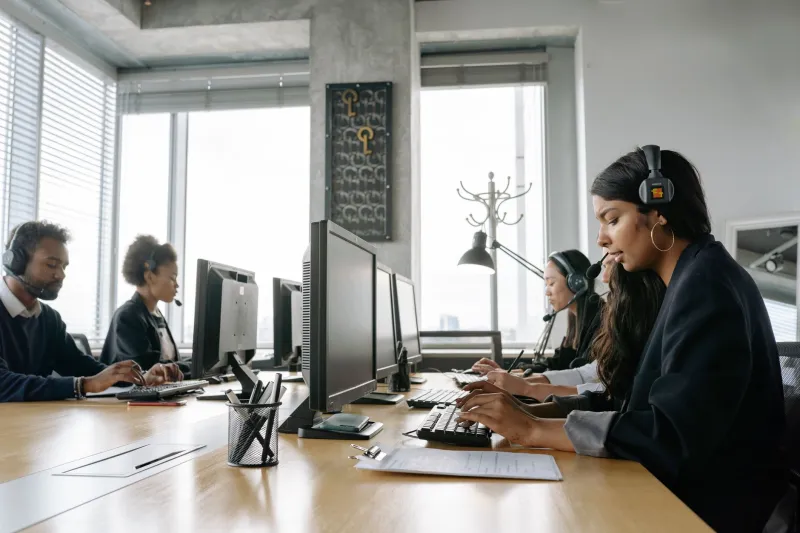
Let's get one thing straight before we begin. The most sophisticated surveillance operation in Omaha's history didn't involve the FBI, a shadowy government program, or even a particularly nosy neighbor with binoculars. It involved a switchboard, a headset, and a rotating cast of exceptionally sharp women who spent their working hours physically connecting the private conversations of Omaha's most powerful citizens — and, if we're being honest, occasionally lingering on the line a half-second longer than strictly necessary.
Welcome to the golden age of the telephone exchange. Population: everyone who ever had a secret in this city.
The Original Network
From roughly the 1920s through the early 1960s, Omaha's telephone exchanges employed hundreds of women as switchboard operators — or as they were formally and somewhat bureaucratically known, "telephone operators" or "central office operators." Their job, on paper, was simple: a caller would pick up the receiver, an operator would answer with the iconic phrase "Number, please," and she would then physically patch the call through by plugging a cable into the correct jack on an enormous lit-up board that looked like something from a science fiction movie.
In practice, the job was anything but simple. These women were required to memorize thousands of numbers, recognize voices by ear, remain unfailingly polite under pressure, and process connections at speeds that would give a modern multitasker a stress headache. The Nebraska Telephone Company — which held a near-monopoly on Omaha's lines for much of this era — trained its operators with almost military precision. Accuracy was mandatory. Efficiency was non-negotiable. And discretion, at least officially, was the whole entire point.
Officially.
What "Central" Actually Knew
Here's where the mystery deepens, because the nature of the switchboard meant that operators weren't just passive conduits. They were active participants in the architecture of communication. When a prominent Omaha meatpacking executive called his attorney at an unusual hour, an operator connected that call. When a city councilman needed to reach a number that wasn't exactly in the public directory, an operator made it happen. When two voices that probably shouldn't have been talking to each other started talking to each other on a Tuesday afternoon, an operator — somewhere in a downtown exchange building, surrounded by the low hum of a hundred simultaneous conversations — was the one who made that connection possible.
Former operators interviewed by local historians over the years have been remarkably consistent on one point: they heard things. Not everything, not always, and rarely with the full context needed to understand what they were hearing. But fragments accumulated. Patterns emerged. A woman who spent a decade at the same exchange board developed an almost involuntary map of who called whom, how often, and at what times of day.
"You didn't try to listen," one retired Omaha operator reportedly told a local oral history project in the 1980s. "But you couldn't exactly not hear it either. The line was open until you pulled the plug."
The Social Geography of a Headset
What makes this story specifically interesting from an Omaha angle is the city's particular social architecture during this era. Omaha in the 1930s through 1950s was a city of rigid hierarchies — old meatpacking money, Union Pacific railroad influence, emerging banking families, and a complex racial and ethnic geography that the city's official history has spent decades quietly tidying up. The telephone exchange sat at the intersection of all of it.
The operators themselves were overwhelmingly working-class and lower-middle-class women, many from South Omaha's immigrant communities. They spent their days connecting calls for the Joslyn family, the Storz family, the various Dundee mansions, and the downtown business elite — a daily ritual that created an accidental but very real cross-class intimacy. These women knew which prominent families were fighting about money. They knew which businesses were struggling before the bankruptcy notices appeared. They knew, in some cases, about affairs, about illnesses being kept quiet, about deals that were never going to be announced in the Omaha World-Herald.
And then, because history has a deeply inconvenient habit of forgetting working women, essentially all of that knowledge walked out the door with them when they retired.
The Erasure Nobody Planned
This is the part that should genuinely bother anyone interested in Omaha's hidden history. The switchboard operators weren't silenced by a conspiracy. Nobody collected their diaries. Nobody threatened them into keeping quiet. The erasure was far more mundane and therefore somehow more complete: their knowledge was simply never considered worth preserving.
Oral history projects that documented Omaha's business leaders, its architects, its politicians, and even some of its more colorful criminals largely skipped the women who had spent decades as the city's unofficial information infrastructure. The Nebraska Telephone Company's own archives, what remains of them, focus almost entirely on equipment, corporate structure, and technology upgrades. The human beings who ran the boards for forty years are footnotes at best.
The automation of telephone exchanges — which rolled through Omaha in waves during the late 1950s and into the 1960s as direct dialing replaced operator-assisted calls — didn't just eliminate jobs. It eliminated a living repository of social memory that had been quietly accumulating for four decades.
What We Can Still Find
For the amateur historian or the merely curious, a few threads remain to pull. The Douglas County Historical Society holds some employment records and corporate documents from the telephone company era. Local newspaper archives — accessible through the Omaha Public Library's digital collections — occasionally feature human-interest stories about operators from the 1940s and 50s that offer glimpses into the culture of the exchanges. And there are, scattered across Omaha's various assisted living facilities and family photo albums, a dwindling number of women (and their children and grandchildren) who carry fragments of this story in their memories.
If you happen to have a grandmother or great-aunt who worked the boards at the downtown exchange on Farnam Street, or at one of the neighborhood exchanges that served Benson or Dundee or South Omaha — now would be an excellent time to sit down with her and a recording device.
The Mystery That Isn't Really a Mystery
Here's the uncomfortable conclusion that any honest investigation of this subject eventually reaches: the reason Omaha's switchboard operators vanished from the historical record isn't really mysterious at all. It's entirely predictable. They were women. They were working-class. Their labor was considered service rather than expertise. And the information they held was the kind of information that the people who write history generally prefer to keep quiet.
The real mystery, if we're going to call it that, is what they might have told us if anyone had thought to ask. What scandals are now permanently sealed? What backroom deals left no paper trail precisely because the only witnesses were women whose testimony nobody thought to collect?
Somewhere in Omaha's past, a woman in a headset knew the answer. She connected the call, pulled the plug at the right moment, and moved on to the next one. And we, collectively, let that knowledge disappear without so much as a "thank you, Central."
Next time you're wandering through the Old Market or driving past one of those grand Dundee mansions, consider this: the real archive of what happened inside those walls wasn't kept in a filing cabinet. It was kept in the memory of a woman at a switchboard who was never once asked to share it.
Have a tip about Omaha's forgotten telephone exchange history? A family connection to the operators who worked the boards? Mystery Man of Omaha is always listening — and unlike Central, we will absolutely pick up on the first ring.