Hello, Central: The Women Who Listened to Everything in Omaha and Told Nobody — Until Now
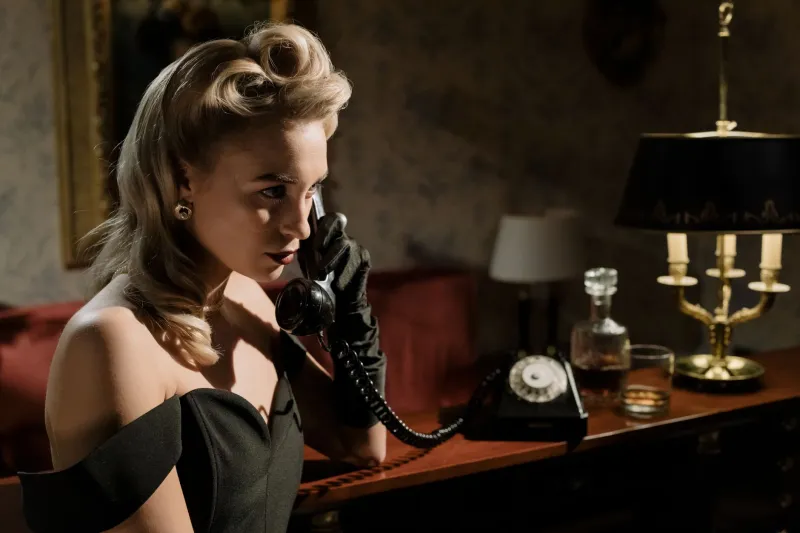
Imagine having a job where your entire professional function is to connect people to each other — to physically plug one person's voice into another person's ear — and to do this thousands of times a day, across a city full of people who assume you're not listening.
Now imagine doing that job for thirty years.
Now imagine retiring and taking everything you know to a quiet house in Dundee, where you tend your garden and never, ever tell anyone what you heard.
That, in broad strokes, is the story of Omaha's telephone exchange operators. And it is, we would argue, one of the great uninvestigated chapters in this city's history.
The Original Information Network
The telephone exchange era in Omaha ran roughly from the 1890s through the 1960s, when direct-dial systems gradually made human operators obsolete for most calls. During that window, every telephone call placed in the city passed through a switchboard staffed by women — almost exclusively women — who sat at massive plug-and-socket panels and manually connected callers to their destinations.
The job required speed, accuracy, a pleasant voice, and — this part is important — absolute discretion. Operators were trained to be functionally invisible. You weren't supposed to notice them. You certainly weren't supposed to think about what they might be absorbing as they connected your call to your accountant, your doctor, your lover, your bookie.
But here's the thing about being trained to be invisible: it doesn't make you deaf.
Operators heard things. Not always complete conversations — the official protocol was to disconnect once a call was connected — but fragments. Tones of voice. Recurring patterns. The same number called repeatedly at odd hours. The nervous hesitation before someone asked to be connected to a number that didn't appear in any directory.
Over years and decades, those fragments added up to something.
What the Exchanges Actually Looked Like
Omaha's main telephone exchange was located downtown, in a building that hummed with a particular kind of concentrated human attention. Rows of operators sat shoulder to shoulder, headsets on, hands moving constantly across the boards. Supervisors walked the floor. The noise was a constant low roar of connection and disconnection, of voices asking and being answered.
Smaller exchanges served specific neighborhoods. Some businesses had their own internal operators. Hotels employed switchboard workers who were, by necessity, intimately familiar with the comings and goings of guests — which, in a city with Omaha's share of traveling salesmen, political figures, and people who preferred not to be found, meant knowing quite a lot.
We tracked down the granddaughter of a woman who worked the Hotel Fontenelle's switchboard in the 1940s and '50s. She asked that we not use her name. "Grandma didn't talk about specific guests," she told us, "but she used to say that the hotel switchboard was where you learned that everyone in Omaha was connected to everyone else, and most of them were trying to pretend they weren't."
That sentence alone could fuel three separate investigations.
The Discretion That Became Permanent
Here's where the mystery deepens into something genuinely frustrating for anyone with an amateur historian's instincts: the operators' silence wasn't just professional habit. It was, for many of them, a point of pride that outlasted their careers by decades.
The women who staffed Omaha's exchanges were trained to understand that their value depended on being trusted. The moment an operator became known as someone who talked, the entire system — social, professional, commercial — that depended on telephone communication became compromised. So they didn't talk. Not to journalists. Not to historians. Not, in many cases, even to their families.
Oral history projects from the 1970s and '80s — the period when researchers were beginning to systematically document working women's experiences — largely missed this population. By then, many of the operators from the golden age of the exchanges were elderly, and those who were approached often deflected with practiced ease. "Oh, I just connected calls. There's nothing interesting to tell."
We find that answer deeply interesting.
Crimes, Scandals, and the Calls That Couldn't Have Gone Unnoticed
Let's be specific about what we're speculating here, because we believe in being upfront about our speculations.
Omaha had its share of documented scandals, crimes, and controversies between the 1920s and 1960s. Political corruption. Organized crime with fingers in legitimate businesses. Affairs that ended marriages and careers. Financial schemes that unraveled publicly but were almost certainly discussed privately long before they became news.
All of these situations involved telephone calls. And all of those calls, at some point, passed through the hands of an operator.
We're not suggesting the operators were spies. We're not even suggesting they were listening in any sustained or deliberate way. But pattern recognition is human. An operator who connected the same city councilman to the same unlisted number three times a week for a year noticed something, even if she never articulated it as "noticing."
What happened to that knowledge? It aged out of living memory. Quietly. Without ceremony.
The Archive That Doesn't Exist
No formal oral history collection for Omaha's telephone exchange operators exists, as far as we can determine. The Nebraska State Historical Society has some documentation of the exchanges as physical infrastructure. Employment records, where they survive at all, are dry personnel files.
What's missing is the human record — the stories, the observations, the carefully maintained discretion that, with the right interview technique and the right relationship of trust, might have yielded something extraordinary.
That window has mostly closed now. The women who worked those boards in the 1940s and '50s would be well over a hundred years old today. A few may have daughters or granddaughters who remember fragments of stories told at kitchen tables, stories that were never meant to go further.
If that's you — if you grew up hearing about a grandmother who worked the switchboard and came home with that particular knowing expression — we would genuinely love to hear from you.
We promise to be discreet. We learned from the best.