Erased from the Blueprints: Omaha's Ghost Architects and the Skyline They Built in Secret
Here's a question that should bother you more than it probably does: Who actually designed the building you're standing in right now?
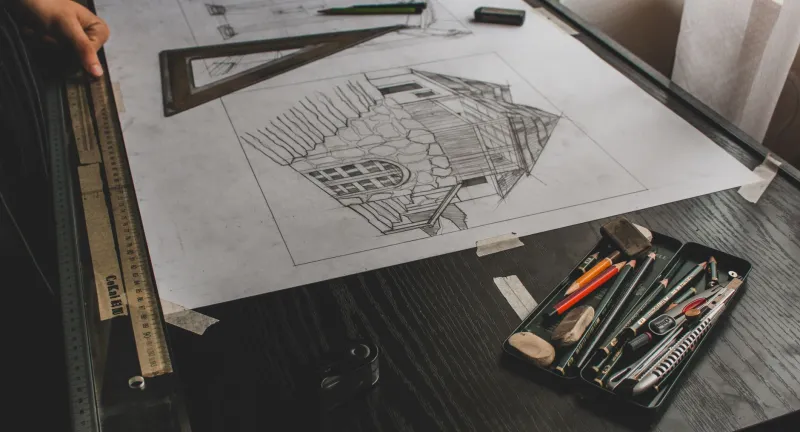
Not the firm. Not the partner whose name appeared on the letterhead. Not the guy who shook hands at the ribbon-cutting ceremony while everyone snapped photographs. The actual person — the one who sat hunched over a drafting table at two in the morning, arguing with geometry until the angles gave up and cooperated.
In Omaha, that question gets uncomfortable fast.
The Name on the Door Wasn't Always the Hand on the Pencil
Let's start with a name most Omahans have never heard: Clarence Durrell. Not a household name. Not a plaque anywhere. Not so much as a footnote in the Douglas County Historical Society's more popular pamphlets. And yet, according to architectural historian Meredith Voss — who has spent the better part of a decade reconstructing the paper trails of early twentieth-century Omaha design firms — Durrell's drafting sensibility shows up in at least a dozen buildings that were publicly credited to his employer, a considerably more famous and considerably more socially connected architect whose name I'll let you look up yourself.
"The junior draftsman problem is everywhere in architectural history," Voss told me over coffee that had gone cold while she talked. "But Omaha had a particular version of it. There was so much construction happening between 1890 and 1930 that firms were essentially running sweatshops of talent. The senior partner signed everything. The junior staff drew everything. And when the junior staff were women or immigrants or Black designers, their contributions didn't just go uncredited — they got actively buried."
Actively buried. That phrase stuck with me for days.
The Demolition That Erased the Evidence
One of the more maddening aspects of this particular mystery is that the buildings themselves — the physical proof of these forgotten architects' genius — kept getting torn down.
Take the case of the Kellerman Commercial Block, a mixed-use structure that stood on a corner of what is now a parking lot nobody looks at twice. Local records suggest it was designed in the early 1910s by a woman named Ida Schreiber, who had trained in Chicago and returned to Omaha to work in relative obscurity. She never ran her own firm. She never got a commission under her own name. But correspondence unearthed from a private collection — letters between Schreiber and a client who apparently didn't know or didn't care that she wasn't the named principal — describes the Kellerman Block's interior layout in specific, proprietary detail.
The building came down in 1962. Nobody protested. Nobody wrote an obituary for it. And with it went the most tangible evidence that Ida Schreiber had ever put pencil to paper in this city.
"This is what happens when preservation efforts focus on famous names rather than architectural quality," says Thomas Aberle, who teaches architectural history at a local university and has made something of a personal crusade out of reassigning credit where credit is due. "We saved buildings because of who we thought designed them, not because of what the buildings actually were. And the 'who' was almost always wrong."
Following the Paper Trail Into the Attic
The detective work required to reconstruct these lost legacies is genuinely extraordinary — and I say that as someone who once spent four hours in a library basement trying to find out whether a particular Omaha speakeasy had a second floor. (It did. That's a different article.)
Aberle's methodology involves cross-referencing permit applications, payroll records from defunct firms, personal correspondence, and — his personal favorite — the handwriting on original blueprints. "Firms didn't always use the same draftsman for the same project," he explains. "If you can match the lettering style on a blueprint to a known sample of someone's handwriting, you've got a pretty strong case."
Using this method, he's tentatively attributed significant design work on several prominent Omaha civic buildings to a draftsman named August Florentin, a Hungarian immigrant who arrived in the city in 1904 and worked for three different firms over twenty years without ever receiving a named credit. Florentin died in 1941. His obituary described him as a "craftsman." He was, by Aberle's reckoning, one of the most sophisticated spatial thinkers to ever work in this city.
Why Does This Keep Happening?
The cynical answer is obvious: credit flows upward, and the people at the top of early twentieth-century architectural firms were almost universally white, male, well-connected, and eager to consolidate their reputations. But the fuller answer is a little more complicated and, honestly, a little more Omaha-specific.
This city has always had an ambivalent relationship with its own history. It booms, it builds, it occasionally tears things down before anyone has thought to write about them. The archival instinct came late here. By the time local historians started systematically documenting the built environment, many of the people who could have provided firsthand accounts were gone, and many of the buildings that could have served as evidence were rubble.
There's also the matter of who gets to tell the story. For most of Omaha's architectural history, that was a fairly narrow group of people with fairly narrow interests in whose contributions got remembered.
What's Still Out There
Here's the hopeful part, and I promise I'm not just saying this to end on a cheerful note: there's still a lot to find.
Private collections across the metro area almost certainly contain correspondence, drawings, and photographs that could reshape our understanding of who built this city. Old newspaper archives — particularly in the foreign-language press that served Omaha's immigrant communities — sometimes contain references to designers and builders that never made it into the English-language record. And the buildings themselves, the ones still standing, still have things to say if you know how to ask.
The Mystery Man of Omaha is formally requesting that anyone with old blueprints, architectural correspondence, or attic full of drafting supplies from a dead relative please get in touch. We are not even slightly joking. We have a very comfortable reading chair and an unlimited supply of questions.
Somebody designed this city. We'd like to know who.