Personals, Peculiarities, and Possible Plots: A Suspicious Tour Through Omaha's Weirdest Newspaper Classifieds
We want to tell you upfront that this investigation started as a joke.
One of our contributors was scrolling through digitized archives of old Omaha newspapers — as one does on a Tuesday night when the streaming options feel uninspiring — and started noticing ads that didn't quite make sense. Not dramatically, conspicuously nonsensical. Just slightly off. The kind of off that you'd scroll past nine times and notice on the tenth.
Three weeks later, said contributor had filled two notebooks, developed strong opinions about 1940s newsprint typography, and begun referring to a specific recurring advertiser only as "The Pelican," for reasons that will become clear.
Welcome to the classified section. It's weirder than you think.
The Basics of Coded Communication Through Print
Before we dive into the Omaha-specific material, a brief primer on why newspapers were historically excellent vehicles for covert communication — because this isn't a new idea, and acknowledging that upfront makes our subsequent speculation feel more grounded.
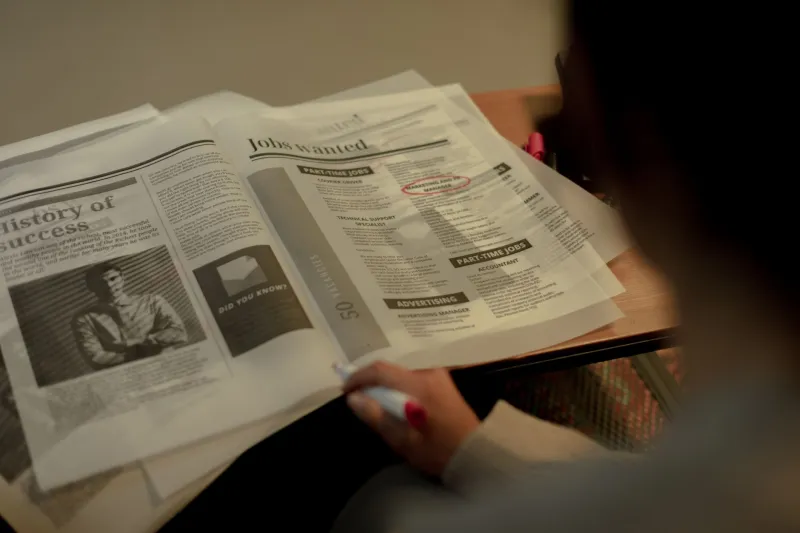
Classified advertisements were, for most of the twentieth century, cheap, minimally scrutinized, and accessible to anyone with a few cents and a visit to the newspaper office. Unlike letters, they left no envelope, no handwriting, no physical trail connecting sender to receiver. A message placed in the classifieds of a major daily could be read by the intended recipient and simultaneously ignored by thousands of other readers who had no reason to find it interesting.
Intelligence agencies used this technique. Criminal organizations used it. Lovers used it. There's solid historical documentation of all three, in cities across the country.
Which brings us to Omaha, and to the question of whether anyone here was doing the same thing.
The Pelican Problem
The ad that started everything appeared in the Omaha World-Herald classifieds section on a Tuesday in March 1947. It read, in its entirety: "PELICAN. Terms acceptable. Contact as arranged. Availability confirmed through Saturday."
No phone number. No address. No indication of what was being offered, sold, rented, or sought. Just the pelican, its acceptable terms, and its confirmed availability through Saturday.
Unremarkable on its own. Possibly a private joke. Possibly shorthand between two parties who knew exactly what it meant. We noted it and moved on.
Then we found another one. Same paper, eleven months later: "PELICAN. New terms required. Saturday no longer suitable. Advise."
And then another, in 1949. And 1951. And 1953, where it shifted slightly: "PELICAN unavailable. Arrangements must change."
After that, nothing. The pelican, whatever it represented, went quiet.
We showed these to a retired postal inspector who has a hobby interest in historical codes and ciphers. His assessment, delivered with the careful hedging of someone who doesn't want to be quoted making wild claims: "It reads like a contact protocol. Whether it's criminal, romantic, commercial, or completely innocent, I genuinely cannot tell you. But it's not random."
Not random. Noted.
Patterns in the Miscellaneous Column
The pelican wasn't alone. Once we started looking — really looking, the way you look at a Magic Eye poster until your eyes cross and something emerges — patterns appeared in the miscellaneous classifieds across multiple decades of Omaha papers.
Certain ads recurred with unusual regularity on specific days of the week. Thursday was particularly active for what we started calling "non-ads" — listings that named items or services that were either impossible to verify or so vague as to be meaningless. "Antique timepiece, unusual provenance, serious inquiries only." "Room available, specific requirements, references exchanged." "Services rendered, discretion guaranteed."
The phrase "discretion guaranteed" appears in Omaha classified ads at a frequency that is, statistically speaking, higher than you'd expect if you'd never thought about this before and then started counting.
We also found a cluster of ads in the early 1950s that used botanical language in ways that seemed structurally odd. Items described as "seasonal," "requiring specific soil," or "best suited to shaded conditions" appeared in contexts — used furniture, housing, employment — where such language made no obvious practical sense.
Local amateur codebreaker Marcus T., who asked that we use only his first name and last initial because he has a professional reputation to maintain, spent an evening with our compiled list. "The botanical cluster is interesting," he told us. "Substitution ciphers often use natural categories — plants, animals, weather — because they're culturally neutral and don't raise flags. I'm not saying that's what this is. I'm saying it's consistent with that."
The Historians Weigh In (Cautiously)
We approached two local historians with our findings. The responses were educational.
The first, a retired academic with deep knowledge of Omaha's mid-century commercial history, was politely dismissive. Classified ads from that era were often written by people with minimal literacy, she pointed out. Unusual phrasing frequently reflected the writer's background rather than any intent to conceal. The pelican, she suggested, might simply have been someone's nickname for a boat, a property, or a business partner, and the recurring ads were a perfectly mundane ongoing commercial relationship.
This is a reasonable interpretation. We're choosing to hold it lightly.
The second historian — a younger researcher who focuses on labor and underground economies — was considerably more animated. He pointed out that the 1940s and '50s were a period of intense surveillance anxiety in American cities. People with reason to communicate carefully — union organizers, political dissidents, people engaged in activities that were criminalized due to their identity or personal lives — had strong incentives to find communication channels that didn't leave obvious trails.
"Omaha wasn't exempt from any of that," he said. "If anything, being a mid-sized city might have made it easier. Less scrutiny than Chicago or Kansas City, but enough of a newspaper circulation to make a classified ad actually useful as a signal."
What We're Not Saying (And What We Kind Of Are)
We want to be responsible here, so let's be explicit: we have not proven that Omaha's classified ads contained coded communications. We have found patterns that are interesting, gathered expert opinions that range from "probably nothing" to "plausibly something," and developed a perhaps unhealthy attachment to a mysterious pelican.
What we're genuinely suggesting is that this is worth more investigation than it has received — which, as far as we can tell, is approximately zero investigation by anyone other than us and Marcus T.
The digitized newspaper archives are publicly accessible. The patterns are there to be examined by anyone patient enough to look. And somewhere in Omaha, there may be someone who remembers exactly what the pelican meant, and why it stopped appearing in 1953.
We'd very much like to buy that person a cup of coffee.
Contact as arranged. Availability confirmed.