Follow the Money (If You Can Find It): The Sealed Vaults and Vanishing Ledgers of Omaha's Forgotten Banking Barons
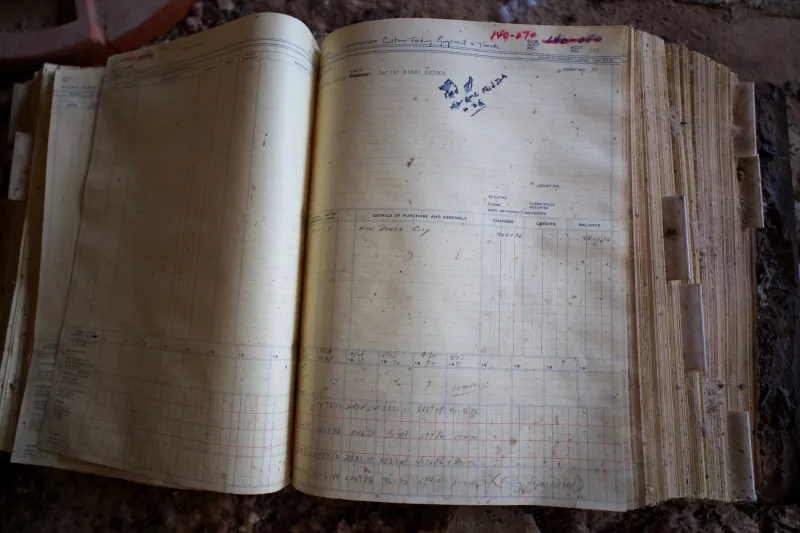
Let me paint you a picture. It's 1897. A very well-dressed man in a very expensive suit walks into a very imposing stone building on Farnam Street, hands a leather-bound ledger to a clerk, and says something to the effect of "put that somewhere nobody will ever look." The clerk obliges. The man tips his hat. And for the next hundred-and-something years, nobody looks.
Welcome to the financial underbelly of Omaha, Nebraska — where the money was enormous, the paper trail was deliberately confusing, and the vaults that might explain everything have been sealed tighter than a pharaoh's tomb. Only slightly fewer curses involved. Probably.
The Men Who Built Omaha's Money Machine
To understand what might be hiding in those old records, you first have to appreciate just how much raw, chaotic, barely-regulated capital was sloshing around Omaha in the late 1800s. The city was a railroad hub, a meatpacking powerhouse, and a gateway to westward expansion — which meant money was flowing in from every direction at once, and the men who controlled its movement became extraordinarily powerful in a very short amount of time.
Figures like Herman Kountze, who co-founded Kountze Brothers Bank, weren't just wealthy — they were structurally embedded in the city's development. Their decisions about who got loans, who got credit extended, and who quietly got called in on a debt shaped which neighborhoods got built, which businesses survived panics, and which families rose or fell through Omaha's social strata. These weren't just bankers. They were, functionally, a shadow government with better furniture.
And like any shadow government worth its salt, they kept meticulous records — records that were never intended for public consumption.
So Where Did All That Paper Go?
Here's where it gets genuinely interesting, and by "interesting" I mean "suspicious in a way that would make any self-respecting amateur detective's left eyebrow twitch involuntarily."
When many of Omaha's early financial institutions collapsed — during the Panic of 1893, the banking consolidations of the early 20th century, or the Great Depression's particularly brutal sweep through the Midwest — their records didn't always follow the orderly archival path you might hope for. Some documents were transferred to successor institutions that have since also disappeared. Some were reportedly destroyed in fires that broke out with convenient timing. Others were placed in private family custody, where they remain to this day, unavailable to researchers and historians who would very much like a peek.
The Douglas County Historical Society has pieced together fragments. The Omaha Public Library's special collections hold tantalizing partial records. But the complete picture? The full ledgers? The personal correspondence between bankers discussing transactions that never appeared in official accounts? Those remain stubbornly, maddeningly absent.
The Embezzlement Rumors That Won't Die
Now we get to the part that would make a true crime fan sit up straight.
For decades, local historians have whispered about a pattern of what might charitably be called "creative accounting" among certain Omaha banking houses during the 1880s and 1890s. The whispers aren't baseless — there are enough oblique references in surviving correspondence, enough abrupt resignations among bank officers, and enough sudden, unexplained transfers of property to suggest that some institutions were doing things with depositor funds that would today result in a very lengthy federal indictment.
One particularly persistent rumor involves a mid-tier bank that operated in the Florence neighborhood and allegedly ran a parallel set of books — one for regulators, one for reality. The institution collapsed in 1896. Its principal officers retired to comfortable circumstances. Its depositors did not. The records that might have explained the discrepancy were reportedly removed from the premises before any official examination could take place. Nobody was ever charged with anything.
Is this documented? Not entirely. Is there enough circumstantial evidence to make you deeply uncomfortable about the foundations of Omaha's early financial culture? Absolutely yes.
What Modern Researchers Are Actually Finding
Here's the genuinely encouraging part: some dedicated researchers are starting to crack this open, one microfilm reel at a time.
Academic historians working through university archives have been cross-referencing property records, probate filings, and the surviving correspondence of Omaha's business elite to reconstruct financial flows that the original participants clearly hoped would stay invisible. What's emerging is a picture of wealth transfer — particularly in the years following the 1893 panic — that doesn't entirely add up through legitimate means alone.
Certain families whose banking operations nominally failed somehow emerged from those failures with their personal real estate holdings not just intact but expanded. Loans made to politically connected borrowers appear in partial records but not in the final accounting of collapsed institutions. And at least one researcher has identified what appears to be a network of interlocking personal accounts used to move money between institutions in ways that would have obscured its origin and destination.
None of this is a smoking gun. But it's a lot of smoke in a room where someone definitely doesn't want you looking for the gun.
The Vault Question
And then there are the physical vaults themselves.
Several of Omaha's former bank buildings still stand, repurposed as offices, restaurants, or mixed-use developments. A few retain their original vault structures — massive steel-and-concrete installations that were simply too expensive and too permanent to remove during renovation. What's in them now varies. What was in them before the renovations? That's a question that doesn't always have a satisfying answer.
At least one Old Market-area building conversion in the 1980s reportedly uncovered a cache of documents in a sealed inner vault room that had been bricked over at some point in the mid-20th century. According to the contractor who found them, the documents were transferred to a private party who claimed ownership of the building's historical contents. Whether those documents were ever examined, catalogued, or preserved is, at this point, unknown.
If that doesn't make you want to put on a metaphorical trench coat and start asking questions, I genuinely don't know what will.
The Ledger Beneath the Ledger
What's ultimately compelling about Omaha's banking history isn't just the possibility of individual wrongdoing — it's what the sealed records might reveal about how power actually worked in a rapidly growing American city before meaningful financial regulation existed. The men who controlled capital in late 19th-century Omaha weren't operating in a vacuum. They were connected to politicians, to railroad executives, to real estate speculators, and to each other in ways that shaped the city's physical and social geography for generations.
The neighborhoods that got investment and the neighborhoods that didn't. The businesses that received credit and the ones that were quietly starved of it. The families that ascended into Omaha's elite and the ones that mysteriously didn't quite make it — despite apparently having every advantage. The ledgers, if we could read them, might explain all of it.
Somebody sealed those vaults for a reason. The Mystery Man of Omaha intends to find out what it was.
Have a tip about Omaha's financial history, a family connection to one of the city's old banking dynasties, or a basement full of suspiciously interesting old documents? You know where to find us.